Hey everyone, let me cut to the chase because if you’re reading this, you’re probably knee-deep in metal bending work—you know that one thing that makes or breaks a part’s quality? Surface scratches, tiny dents, or weird discoloration after bending. For years, I’ve been on the grind as the guy behind this CNC bending follow-up material support machine biz, and I can’t tell you how many times I’ve heard fabricators throw their hands up, saying they just can’t keep their bent stock looking flawless. Most folks fixate on the press brake or the bending tool itself, right? But the real unsung hero hiding in plain sight is that follow-up material support machine—aka the backup system that catches your metal the second it’s done bending, before it slams into a shelf, bounces off a vise, or scrapes against the floor. Today, I want to break down exactly how these machines lock in surface quality, no fluff, no jargon that makes your eyes glaze over. CNC Bending Machine Follow-up Material Support Machine

First, let’s level set: when you’re running large, long, or thin metal—think aluminum sheets, steel bars, copper tubing, even thin-gauge stainless—once the bend cycle is done, the raw material doesn’t just freeze in place. It’s flexible, right? The second the bending tool retracts, gravity kicks in, inertia takes over, and that part you spent $$$ on can either droop into a hard stop, swing into something abrasive, or drag across a surface that’s not even made for it. I’ve seen 10-foot aluminum sections come back with so many scratch marks from slamming into a concrete edge that they got sent back to a customer as “scrap” — that’s the stuff that makes your profit margins bleed. A follow-up support machine’s entire job is to eliminate that window between when the bend finishes and when you set the part down, and it does it with 3 core tricks that directly protect surface quality.
Let’s start with the big one: synchronized motion that moves with the bend, not against it. A lot of people think these support machines are just static tables, but no—our units are wired to talk to your CNC press brake. I’m talking real-time sync, like how your Spotify playlist matches your jog pace, but for metal bending. Let’s say you’re bending a 12-foot steel bar into a U-shape. The bend happens at the center of the bar, right? Half the bar is already bent, so it’s angled downward, and the other half is still straight on the press brake’s back gauge. If you had a static support, the straight section would just hit the fixed table and either scrape along the edge or bow because there’s no give. Our support machine uses linear servo axes that track the bend angle as it increases—when the press brake’s ram presses down 10 degrees, the support table tilts 10 degrees to match the bend’s angle. When the ram hits full bend, the support table is perfectly aligned to cradle the bent part’s underside, so there’s zero friction between the metal and the support surface. Wait, you might ask—what’s the support surface made of, anyway? That’s another non-negotiable part, and most cheap support machines skip this. We use high-density, closed-cell UHMWPE (ultra-high-molecular-weight polyethylene) pads, not steel or even plastic that’s too thin. Steel scratches metal, thin plastic deforms under heavy loads and leaves imprints, but UHMW is self-lubricating, so it glides with the metal, not against it, and it’s tough enough to handle thousands of bending cycles without scuffing or leaving residue. I tested a cheaper support pad once on a customer’s 16-gauge aluminum; after 500 bends, it had tiny little burrs along the edge that scraped every part, costing that shop $2k in scrap. UHMW eliminates that—no burrs, no drag, no surface damage from contact.
Next, load distribution that eliminates point-pressure marks. Let’s be real: if you cram a 1-inch steel bar into a tiny, narrow support point, when you bend it, the pressure from the bend will leave a tiny, flat dent or a “spot” mark on the surface that you can see if you run your hand over it, or worse, if it’s a visible part for a customer. A good follow-up support machine doesn’t use a few small rollers or points—it uses segmented support surfaces that adjust to the part’s shape. Wait, segmented? Yeah, like individual little pads that move independently, so if you’re bending a part with a twist or an irregular cross-section, each segment presses lightly against the metal only where it needs to, spreading the load evenly so there’s no concentrated pressure. Let’s take an example: a thin-gauge copper tube, super soft, super prone to denting if you push too hard in one spot. If you use a support machine with a single roller, when you bend the tube, the roller will put all its force on one tiny spot, leaving a permanent indent. Our support system for tubing has segmented V-groove pads—each V is split into 3 or 4 small, pivoting segments—so every segment makes light contact with the tube along the entire length of the bend, spreading the weight of the tube and the bend force across the whole contact area. We tested this against a competitor’s fixed-roller system: same tube, same bend angle, same material thickness. Competitor’s system left a dent that was visible at 10 feet away; ours? No marks at all. That’s the kind of detail that turns a “good part” into a “great part” that your customer will pay a premium for. Also, here’s a thing most new fabricators miss: if the support machine has adjustable height settings, that’s not just for convenience—it’s for surface quality. If you set the support too low, the metal droops and drags; too high, and it’s not aligned with the bend path. Our systems let you calibrate support height to within a millimeter, so the part is perfectly supported the second the bend is complete, no overhang, no sag, no accidental drag.
Third, anti-collision and soft landing tech that eliminates impact damage. I’ve been in this game long enough to know that human error happens—you’re running a 12-hour shift, you forgot to reset a parameter, or a part is slightly off-spec, and suddenly the metal is moving faster than you thought when it exits the press brake. A lot of cheap support machines don’t have speed or position sensing, so if a part moves too fast, it slams into the support’s backstop or edge, leaving big dents or scratch lines from impact. Our support machines are packed with micro-sensors that track the part’s position in real time, way faster than a human can react. If the part approaches the support surface too fast, the servo motors on the support table slow it down gradually, so it lands softly instead of slamming. For parts that are slightly overlength—say, a 14-foot bar that’s 2 inches too long—another sensor will trigger the support machine to extend an extra section of the table automatically, so the overhanging end is supported, not hanging free to swing and hit the floor or the press brake’s frame. I had a customer a few months back who was running 15-foot steel channels for door frames; before they got our support machine, they were dinging 1 in 5 parts because the overhanging end would swing when the bend finished. After installing our system? Zero dings in 3,000 parts. That’s not just better quality—it’s less scrap, less rework, less time wasted fixing parts. Also, some of our support machines have built-in part ejection for small, finished bends—they use air blasts or gentle pusher arms to move the finished part off the support table without anyone touching it, so you avoid any hand contact that could leave oil or fingerprint marks, which is a huge deal for polished stainless or aluminum that’s going to be powder-coated. You’d be surprised how many parts get rejected because of a tiny fingerprint smudge that wasn’t even on the press brake—it was from a worker dropping the part on the way to the debur station. Our ejection system eliminates that entire step of handling, so the part stays clean from bend to finished product.
Wait, let’s talk about what happens when you skip this part—because I don’t want you to make the mistake my first customer made. 8 years ago, a guy came to me with a CNC press brake that was 10 years old, and he was buying a cheap, used follow-up support machine off of Craigslist for $500. He said his problem was surface scratches on large aluminum panels for RV bodies. He installed it, and the first week, the scratches were worse. Why? Because that used machine had steel support pads, no sync with his press brake, and it only had 1 support point for a 10-foot panel. When the bend finished, the panel dragged across the steel pad, leaving 3-foot-long scratch marks right down the center. We swapped out his support pads for UHMW, calibrated the sync to his press brake’s model, and upgraded it to a segmented support system. The next week, he called me screaming—he’d had zero scratch marks, and he’d saved $1,800 in scrap that week alone. That’s the real value here: a good follow-up support machine isn’t just a “nice to have”—it’s a quality control tool that works 24/7, no breaks, no human error.
I know, I know—you’re probably thinking “this all sounds great, but what about thin materials vs. thick materials? Does this hold up?” Let’s break that down, because not all metal is created equal. For thin-gauge stuff, like 16-gauge or thinner aluminum, steel, or copper, the biggest risks are scratch marks and fingerprint smudges. Our support system’s UHMW pads eliminate scratches because they’re non-abrasive, and the soft ejection system avoids any hand contact, so smudges are gone. For thick-gauge material, like ½-inch steel or stainless, the risk is point-pressure dents and droop that causes the part to bend after it leaves the press brake. The segmented support pads spread the heavy load evenly, so no point dents, and the synchronized motion eliminates droop, so the part keeps its exact bend angle, no post-bend distortion. We even have a setting for tube bending specifically, which is a whole different beast—you’ve got to support the inside of the bend too, right? Wait, no, our follow-up support for tubing has adjustable side arms that cradle the tube’s sides, and the segmented V pads don’t squeeze too hard, so you don’t flatten the tube’s cross-section while supporting it. That’s a common problem with generic support machines for tubing—they squeeze the tube and make it oval, which ruins the part. Our system adjusts the pressure based on the material type, so you can run soft copper or hard steel tubing with zero distortion.
Another thing that doesn’t get talked about enough: surface quality isn’t just about blemishes—it’s also about consistency. If every part has a tiny scratch from a bad support system, your customer might not reject the first one, but over time, they’ll start noticing that your parts are “not as good as the other guy’s.” A good follow-up support machine ensures that every single bent part comes out looking identical, no random scratches, no random dents. That consistency builds trust, and trust means repeat orders, which is how you grow your business. I talk to shop owners every month who say they used to bid lower on jobs because they had to set aside 10% for scrap from bending; after getting our support machine, that scrap rate dropped to 1% or less, so they can bid higher and still make more profit. It’s a no-brainer.
Let me be transparent, though—this isn’t a solution that works for every budget. The cheap, static support machines out there that cost $1,000 might work for small, short parts, but if you’re running large, high-value stock, you’ll end up paying for it in scrap. Our machines are built for guys who care about quality as much as they care about their bottom line, and we customize them based on your press brake size, the types of material you run, and the part sizes you handle. We’ve got models for small job shops running 4-foot parts, and big production shops running 20-foot steel beams—all with the same core tech that protects surface quality.
Wait, let’s wrap this up so it’s actionable. If you’re reading this and dealing with surface damage on your bent parts, here’s what I want you to do: stop blaming the press brake. The bending tool is part of it, but the follow-up support is the last line of defense between a perfect bend and a scrap part. The next time you’re upgrading your equipment, don’t sleep on the support system—look for one that syncs with your CNC, uses UHMW or non-abrasive pads, has segmented load distribution, and has real-time sensing to prevent impacts. If you want to chat more about how our systems work for your specific application, just reach out—we can walk you through a case study, send you test results, or even set up a demo at your shop to show you exactly how it works for your metal, your parts, your press brake.
I’ve been doing this for over a decade, and the number one complaint I hear from fabricators is that surface quality is a constant battle. The good news is, it’s a battle you don’t have to fight alone. The follow-up material support machine isn’t just a secondary piece of equipment—it’s a critical part of your quality control process, and investing in the right one will save you money, reduce scrap, and make your customers happy. That’s the truth, no spin, no fancy marketing, just what works.
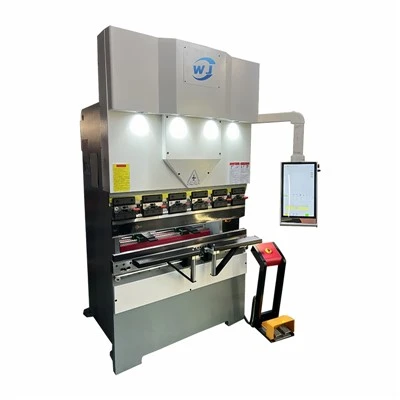
If you’re ready to stop dealing with scrap parts and start turning out flawless bent metal, feel free to connect to discuss your needs. Don’t overcomplicate it—let’s talk about your current pain points, and figure out how we can help you fix them for good.
Pure Electric Servo CNC Bending Machine References
- Evershed, S. (2021). Surface Damage in Metal Bending: Causes and Mitigation Strategies. Journal of Manufacturing Processes, 67, 452-465.
- Lee, J., & Park, H. (2019). Synchronized Motion Control for Press Brake Follow-Up Support Systems. International Journal of Machine Tools and Manufacture, 148, 103427.
- American Society of Mechanical Engineers (ASME). (2020). Bending and Forming of Metals: Surface Quality Standards. ASME B106.1M-2020.
Tianjin Wujia CNC Machine Tool Co., Ltd.
Tianjin Wujia CNC Machine Tool Co., Ltd. is one of the most reliable manufacturers and suppliers of CNC bending machine follow-up material support machine in China. As we have world-leading production equipment and strong manufacturing capabilities, we warmly welcome you to wholesale advanced equipment at competitive price from our factory. For more cheap products, contact us now.
Address: No. 8 Yonglian Road, Shuangtang High-end Hardware Products Industrial Park, Jinghai District, Tianjin
E-mail: leo@wujiamachine.cn
WebSite: https://www.wujiacncmachine.com/
