If you’ve ever hung around a compressed air system shop floor, worked on a paint booth, or dealt with a pneumatic tool that randomly seized up out of nowhere, you’ve probably heard someone throw around the term “pressure dew point” like it’s some magical fix-all for bad air. And if you’re shopping for an air dryer right now, you’ve definitely heard it’s one of the most important specs to nail down—way more than just “how big is the tank?” or “does it come with a filter?” Air Dryer

Let me cut through the jargon first, because I’ve had too many customers come in thinking pressure dew point is just “the dew point at my house on a humid day.” Nah, it’s way different. Let’s start with basics anyone can wrap their head around: dew point, plain and simple, is the temperature at which water vapor in air turns into liquid, right? If you leave a cold soda on your porch in summer, beads of water form on the outside because the cold soda cools the air right next to it down to its dew point—so the moisture can’t stay gas anymore, it condenses into droplets. That’s regular dew point, measured at atmospheric pressure (roughly 14.7 PSI, for anyone who doesn’t live by PSI numbers).
But compressed air systems? We’re not working at atmospheric pressure. When we cram air into a compressor, we’re cramming it under pressure—usually anywhere from 90 to 150 PSI, sometimes way higher for specialty jobs. Here’s the big science part that trips everyone up: when you compress air, the space for water vapor shrinks. That means more moisture gets packed into the same volume of air under pressure, which raises the dew point a ton. Like, a random stat I toss around all the time: air at atmospheric pressure that has a dew point of 50°F will have a pressure dew point of around 38°F when compressed to 100 PSI. That’s a huge jump—so if you thought a dryer that hits 50°F atmospheric dew point would work for your system at 100 PSI, you’d be dead wrong. It would only get your compressed air down to 70°F, and you’d have water pooling in your lines before the end of the shift.
Now, as an air dryer supplier, I can tell you this is where most mistakes get made. I’ve seen it a hundred times: a bakery orders a standard refrigerant dryer because it’s cheap, thinks it’s getting a -40°F dew point, and then wonders why their dough mixing lines are freezing over in winter. Or a metal fabrication shop buys a unit with a “35°F pressure dew point” spec and complains their pneumatic saws are rusting within six months. Wait, why’s that mismatch happening? Because most dryer specs list pressure dew point as the number they hit at their rated max operating pressure. If your system runs at 125 PSI, and the dryer’s spec is at 100 PSI, that 35°F number jumps to like 40°F at 125 PSI—enough to cause issues if your facility runs consistently cold overnight.
Let’s break down the two main types of dew point folks care about, because that’s where the confusion lives. First, there’s pressure dew point (PDP, for short—everyone in the industry uses this, don’t overcomplicate it) which is the actual dew point of your compressed air, at whatever pressure your system is running. That’s the real number you need to care about, not atmospheric. Then there’s atmospheric dew point (ADP), which is what you’d get if you let that compressed air expand back down to 14.7 PSI. A lot of dryer brands will advertise ADP numbers because they sound more impressive—like “our dryer hits -40°F ADP!” but that translates to like -10°F PDP at 100 PSI. For applications that need super dry air (like electronics manufacturing, or laser cutting that can’t handle moisture ruining lenses), that difference is night and day.
Now, why does pressure dew point even matter? Let’s get specific with real-world pain points I see every week. If you’re running a pneumatic conveyor for pharmaceutical powders? Even a tiny bit of water in the air can make powder clump, mess up batch consistency, or even breed bacteria. If you’re operating a spray paint line? Water in compressed air causes “fish eyes” on the paint finish, blistering, and you end up reworking half the parts, which costs way more than a decent dryer. If you’ve got air tools on a construction site? Moisture can rust the tool internals, make lines freeze up in cold weather, and even cause pressure drops that slow down jobs. And for food and beverage facilities? OSHA requires compressed air that touches product to be dry and free of contaminants—so missing your PDP spec isn’t just an inconvenience, it’s a compliance risk.
But here’s the thing I always tell customers: you don’t need the lowest possible pressure dew point on the market, even if it sounds cool. A desiccant dryer that hits -100°F PDP is overkill for a garage that uses a 90 PSI air tool a few times a week. That’s like buying a commercial grade vacuum for cleaning your apartment—works, but you’re wasting money on specs you’ll never use. The sweet spot? Match your dryer’s PDP to your application’s requirements. For most general industrial use, a 35°F PDP is enough to prevent line condensation and tool rust. For food and beverage, you’ll usually want a -40°F PDP to meet FDA standards. For laser cutting or pharmaceutical processing, that -100°F PDP might be non-negotiable.
Wait, let’s talk about how different dryers hit different PDPs, because that ties straight back to what you’ll actually buy. Refrigerant dryers (the most common, budget-friendly ones) use a cooling system to pull moisture out of compressed air. They can reliably hit between 35°F and 50°F PDP, which is why they’re the go-to for shops that don’t need ultra-dry air. They’re low-maintenance, cheap to run, and perfect for general use. But if you need lower than 35°F? You’ll go with a desiccant dryer, which uses porous materials (like activated alumina or silica gel) to absorb water vapor. These come in two main types: regenerative desiccant dryers, which swing between heating up to dry the desiccant material, and heatless desiccant dryers, which use a small portion of dry air to purge the desiccant. Heatless ones are good for smaller, consistent load applications, while heated ones work for bigger, higher-demand systems. Both can hit -40°F, -70°F, even -100°F PDP, but they’re more expensive upfront and a bit higher on maintenance.
I’ve had customers ask me before, “Can I just add a filter to fix my bad pressure dew point?” Nope, filters only catch liquid water and solid contaminants—they don’t pull water vapor out of compressed air, which is exactly what dew point is measuring. A 5-micron filter won’t make your air any drier, it’ll just keep dirt out of your lines. That’s another super common mistake that wastes people’s time and money.
Another thing that affects pressure dew point I don’t see enough people talking about? Your system’s load. If you run your compressor at full capacity all day, the air gets hotter and holds more moisture, so the pressure dew point will shift up a little. If your system has a variable speed drive compressor, that can help stabilize your PDP, because it’s not cycling on and off and putting inconsistent pressure into the dryer. And ambient conditions around your compressor room matter too—if your compressor is sitting in a sweltering, unventilated corner of the shop, the incoming air is already more humid, so the PDP of your compressed air will be higher than if you had it in a cool, well-ventilated space.
Let me give you a real example from last month, to make this concrete. A local custom cabinet shop called me panicking—their spray paint lines were getting ruined, and their painter was saying “the air is wet” every morning. They’d bought a used refrigerant dryer off Craigslist for a good deal, but they didn’t check the PDP spec. Turns out that dryer was rated for 100 PSI, but their system ran at 130 PSI. At 130 PSI, that dryer’s 35°F PDP at 100 PSI jumped to 42°F. Combine that with their compressor room being 90°F in the summer, and their morning ambient temperature dropping to 55°F? The pressure dew point of their air was hitting 55°F every night, so when they turned the lines on in the morning, all that moisture condensed right onto the wet paint. We swapped their existing dryer for a slightly bigger refrigerant model rated for 150 PSI, and now their PDP holds steady at 38°F, and their rework rate dropped by 80% in two weeks. That’s the kind of problem I live for solving—when someone gets the spec wrong and doesn’t realize it until something breaks.
So, to circle back to the original question: what is pressure dew point of an air dryer? It’s not just a temperature number on a spec sheet. It’s the real measure of how dry your compressed air actually is, under the pressure your system runs at. It’s the difference between a paint job that looks perfect and one that gets tossed. It’s the difference between pneumatic tools that last five years and ones that rust out in one. It’s the difference between meeting OSHA or FDA requirements for food production and getting a fine you can’t afford.
If you’re here because you’re shopping for an air dryer and you’re confused about all this—don’t stress. This is exactly what we do. We help folks figure out their system’s pressure, their application’s needs, and match them to a dryer with the right pressure dew point, no overkill, no hidden fine print. We’ll walk you through the math, explain the differences between refrigerant and desiccant dryers, and make sure you don’t make the same mistakes that cabinet shop did last month. Whether you’re a small shop with a single air tool or a big industrial operation with 10 compressors, we’ve got the right setup for you.
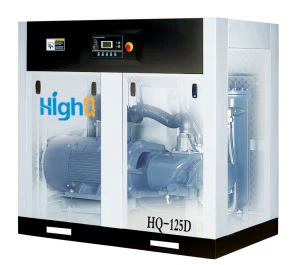
If you’re ready to chat, just reach out. We don’t push the most expensive unit on the market, we push the one that works for your needs. Let’s get your compressed air dry, so you can stop dealing with line condensation, tool rust, and bad paint jobs.
Dry Oil Free Screw Air Compressor References:
- Compressed Air and Gas Institute (CAGI). Compressed Air Treatment Equipment: Pressure Dew Point Definitions and Applications. 2021.
- ASME B106.1M-1985. Measurement of Fluid Flow in Pipes Using Orifice, Nozzle, and Venturi. American Society of Mechanical Engineers, 1985.
- Miller, R.G. Compressed Air System Design and Maintenance. Industrial Press, 2019.
- International Organization for Standardization. ISO 7183: Compressed Air for General Use – Contaminants and Quality Classes. 2019.
Xiamen HighQ Compressor Co., Ltd.
With over 20 years’ experience, Xiamen HighQ Compressor Co., Ltd. is one of the most professional air dryer manufacturers and suppliers in China. We warmly welcome you to buy high quality air dryer made in China from our factory. Good service and punctual delivery are available.
Address: 7th F. No.704 Yi Hua Center Xiamen China 361100
E-mail: vincent@hqcompressor.com
WebSite: https://www.hqcompressor.com/
