Hey there, let’s talk about something that’s probably hidden in plain sight in your office, home office, or even your latest conference room upgrade—power grommets vs. power data grommets. If you’ve ever stared at a desk cutout wondering if you should plug only your laptop charger there or if you can sneak in a monitor and a Ethernet cord too, this post is for you. I’ve been in the power grommet game for, let’s say, long enough to field this question every single week from contractors, office managers, and even random side hustlers building home studios. No boring jargon here, just the real tea on what makes these two totally different, and why picking the wrong one might leave you yelling at a dead laptop mid-presentation. Power Grommet
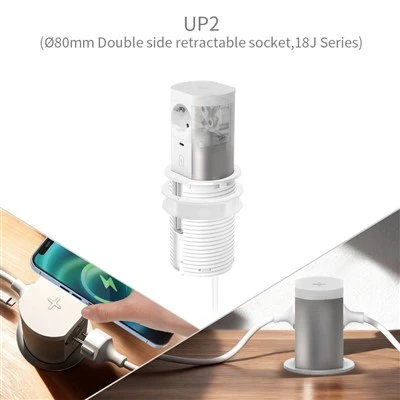
First, let’s break down the basics of what a power grommet even is, just to make sure we’re all on the same page. A grommet (in case you don’t know) is that circular cover that sits in a hole you cut in a desk, table, or countertop—its whole job is to clean up that messy cut edge, and hide all the cords running under the surface. A power grommet takes that a step further: it’s the grommet that has built-in power outlets, so you don’t have to run extension cords all over your desk. That’s the core idea. So far, so simple. Now, the power data version? That’s the one that throws in data ports too, right? But let’s not stop at surface level—there’s more nuance than “one has data, one doesn’t.”
Let’s start with the OG: the standard power grommet. This bad boy is all about electricity, full stop. It’s made to deliver AC power to your devices, period. Most standard power grommets have 2 or 4 outlets on them—sometimes more, depending on the size of the desk cutout you’re working with. The electrical wiring inside is just regular 12/2 or 14/2 gauge copper wire (that’s the industry standard for US applications; some places use different gauges but same vibe) that’s sized to handle the load of whatever you’re plugging in.
Wait, let’s talk load capacity real quick because this is where people mess up. A standard power grommet usually has a max amperage of 15A, which is your regular household outlet capacity. That means you can plug in a laptop, a phone charger, a desk lamp, maybe even a small coffee maker if it’s in your home office (though don’t test that, trust me—15A is enough for most desk stuff, but not heavy-duty tools or space heaters). The key here is: none of this wiring is set up for data. The inside is just two hot wires, a neutral, and a ground—no extra shielding, no ports for Ethernet, USB, HDMI, or anything that moves data. It’s literally just power on tap.
Where does this make sense? Let’s say you’re outfitting a new open-plan office where most people have wireless everything—laptops with Wi-Fi, wireless mice, maybe wireless headphones. They just need a spot to plug in their charger and maybe their monitor, and they don’t care about a hardwired connection. A standard power grommet is perfect here. It’s cheap, easy to install, gets the job done, and doesn’t have extra stuff you don’t need. I’ve sold a ton of these to small businesses renovating their offices last year because they just wanted to cut down on the number of power strips sitting on desks, and that’s exactly what these are for.
Now, the power data grommet—this is the fancy upgrade that has people confused. Let’s get this straight: power data grommets aren’t just a power grommet with a USB port jammed in. If you tried to do that, you’d get some really bad data transfer speeds, or even interference that makes your Wi-Fi cut out. The reason? Data ports (like Ethernet, USB-C, HDMI, even DisplayPort) need their own dedicated wiring inside the grommet, separate from the power wiring. And that wiring has to be shielded, because power and data don’t play nice together—they can cause electromagnetic interference (EMI) that ruins your internet or makes your monitor flicker.
Most power data grommets split the internal space into two separate “channels”: one for power, one for data. The power channel is still that 15A or sometimes 20A wiring for your outlets, just like the standard one. The data channel has its own shielded cables—usually Cat6 or Cat6a Ethernet cables for wired internet, USB 3.2 Gen 2 or Thunderbolt 3 ports for fast data transfer, sometimes even HDMI for video. The best ones actually have a metal barrier between the power wiring and the data wiring to keep EMI as low as possible. That’s the big difference I always tell people: a power data grommet isn’t just adding data ports—it’s engineered to separate power and data so they don’t mess each other up.
Let’s get into use cases here because that’s where the rubber meets the road. When would you need a power data grommet? If you’re setting up a conference room with a big screen, a projector, and a AV cart, for example. You might need to plug in the screen’s power, the laptop’s power, and also run a hardwired Ethernet for the presentation laptop so it doesn’t drop Wi-Fi mid-pitch. Or if you’re building a home studio—like a content creator who has a desk with a capture card, a monitor, and a gaming PC. You might need power for all that, plus a Thunderbolt connection to external drives, Ethernet for streaming, and HDMI from your PC to your monitor. A standard power grommet can’t handle that data stuff without interference, so you need the power data version.
Another big one: boardrooms that do a lot of Zoom calls. A lot of people think Wi-Fi is fine for Zoom, but if you have 10 people in a boardroom all on Wi-Fi at the same time, it’s going to lag. A power data grommet lets you run a hardwired Ethernet cable right to your laptop, which is way more reliable. And if you need to connect to the room’s AV system, some power data grommets even have HDMI or DisplayPort ports so you don’t have to run a separate HDMI cord around the room. That’s the convenience factor—one cutout in your desk, one grommet that does everything instead of three separate holes for power, Ethernet, and HDMI.
Wait, but there are downsides to power data grommets, right? Let’s be honest, I don’t just sell these— I tell people when they don’t need ‘em. First, they’re more expensive. Like, way more. A standard 4-outlet power grommet might cost you $20-$30, while a power data grommet with two outlets, a Cat6 port, and two USB-C ports could be $60-$100, depending on the specs. Second, they’re bigger. Because you have separate power and data channels, the grommet body is wider, so you need a larger desk cutout. Most standard grommets need a 2.5-inch hole, while power data ones often need 3-inch or even 3.5-inch. That’s not a big deal if you’re cutting a new desk, but if you’re retrofitting an old desk, that’s more work to cut a bigger hole.
And let’s not forget about installation complexity. A standard power grommet is basically just running a power cord up through the desk hole, connecting it to the outlets inside the grommet, and plugging it into a wall. A power data grommet means you have to run the data cables too—pulling Cat6 through the desk, connecting Ethernet jacks, testing the data ports to make sure they work. If you’re not handy, that’s extra time or cost hiring an electrician or tech. For a lot of people, that’s overkill. If all you need is power, why bother with the hassle and cost of data ports you’ll never use?
Another common misconception: people think power data grommets handle more power. Nope, not usually. Unless you get a heavy-duty industrial version, most power data grommets still cap out at 15A, same as standard. The only difference is the extra data wiring. If you need power for heavy equipment, like a 3D printer or a large monitor that pulls more than 15A, you need a different type of power grommet entirely—still not a data one, because the data ports can’t handle the high power load anyway.
Let me share a quick story to drive this home. A few months back, a small design firm reached out to me, panicking. They had installed standard power grommets in their new office, but a couple of their graphic designers were complaining that their monitors flickered when they plugged in their external hard drives. Turns out, the electrician they hired ran the power cord and the Ethernet cord for their new printers through the same desk channel, and the EMI from the power was messing with the monitor and the data transfer. We suggested they swap those two standard grommets out for power data grommets, which have the shielded data wiring separate from power. That fixed the flickering and the slow file transfers—no more headaches for the team. That’s the exact scenario where you need the data version, not the standard one.
Now, let’s recap the key differences to make this easy, no notes needed:
- Core Function: Standard power grommets = power only. Power data grommets = power + dedicated, shielded data ports.
- Internal Wiring: Standard = single power circuit. Power data = split power/data channels with shielding to avoid EMI.
- Use Case: Standard = wireless devices, casual office use, home offices with Wi-Fi. Power data = hardwired internet, AV setups, content creation, conference rooms.
- Cost & Size: Standard = cheaper, smaller cutout. Power data = pricier, larger cutout, more installation work.
Wait, but what about USB ports? A lot of standard power grommets have USB-A or USB-C ports built in, right? I get this question all the time. Is that a data port? Well, it is, but it’s a low-power one. Most of those USB ports on standard power grommets are for charging only—they don’t support data transfer. So if you plug your phone into that USB port, it charges, but if you plug an external hard drive, it won’t transfer files. That’s not a real data port, that’s just a convenience feature for charging. So don’t confuse that with the actual data ports in a power data grommet. That’s a common mix-up, and it’s something I always clarify with customers so they don’t buy the wrong thing.
Another thing to consider: compliance, if you’re buying for a commercial space. A lot of office projects have to meet National Electrical Code (NEC) standards. Power data grommets have to be tested to make sure their internal wiring meets NEC for both power and data, whereas standard power grommets just have to meet power standards. For home use, that’s not a big deal, but for commercial builds, you want to make sure whatever you buy is UL-listed or meets local safety codes. I make sure all the power grommets I sell are UL-listed, because I don’t want to deal with a customer’s safety issue down the line.
So, when do you pick which one? Let’s make a quick decision tree for you:
- If all your devices are wireless (Wi-Fi, Bluetooth) and you just need a spot to plug in chargers, lamps, or monitors, go with standard power grommet. It’s simple, cheap, and works perfectly.
- If you need hardwired internet, want to connect AV equipment (monitors, speakers, projectors), transfer large files fast, or run external devices that need stable data connections, go with power data grommet. The extra cost and work are worth it for the reliability.
- If you’re not sure, ask a pro (or just reach out to me, I’m happy to chat through your setup). Don’t guess—you’ll just end up with a grommet that doesn’t do what you need, or a desk that’s full of messy cords anyway.
Now, let’s talk about trends, because the world of grommets is changing a little. More and more, people are opting for grommets that are retractable, so you can push the cover down when you don’t need the ports, keeping your desk looking clean. Both standard and power data grommets come in retractable versions, which is a nice touch if you care about desk aesthetics. Also, wireless charging is becoming a common add-on to standard power grommets, which is cool, but again—still power only, no data.
Wait, I should also mention installation tips, just in case you’re DIYing. For standard power grommets: make sure your desk has enough space under the cutout for the cord to move. If it’s a thin desk (less than 1 inch thick), a standard grommet works, but if it’s thicker, you might need a longer power cord. For power data grommets: when running the data cables, leave some slack under the desk, don’t pull them tight—tight cables can damage the shielding, which causes EMI. And test all the data ports before you finish installing, so you don’t have to take the grommet apart later to fix a bad connection.
At the end of the day, the whole point of a grommet—whether power or power data—is to clean up your workspace. No more messy cords hanging off your desk, no more tripping over extension cords, no more dead laptop mid-meeting. The last thing you want is to pick the wrong one and realize you wasted money on features you don’t need, or worse, don’t have the features you do need.
If you’re planning a renovation, building a home studio, or just outfitting your office and want to make sure you get the right grommet, hit me up. I’ve worked with everything from small home offices to Fortune 500 boardrooms, so I can help you figure out exactly what you need, no sales pitch, just real advice. I don’t push power data grommets on people who only need power— I sell what works for their setup. That’s why most of my customers come back when they need more, and refer their friends.

No fluff, no jargon, just the straight facts on power vs power data grommets. Hope this clears things up, and if you have more questions, don’t hesitate to reach out. Let’s make your workspace a little less messy, and a lot more functional.
Build in Power Strip References:
National Electrical Code (NEC) 2023, Article 406 for receptacle ratings
Underwriters Laboratories (UL) Standard 60950-1 for information technology equipment
TIA-568-C.2 for twisted-pair cabling standards
Cixi Mingye Communication & Electronic Co., Ltd.
Cixi Mingye Communication & Electronic Co., Ltd. is one of the most professional power grommet manufacturers and suppliers in China, featured by quality products and good service. Please rest assured to wholesale durable power grommet at competitive price from our factory. Welcome to contact us for custom service and ODM service.
Address: West Industrial District,Guanhaiwei Town,Cixi city,Zhejiang Province,China
E-mail: enquiry@officelink.com.cn
WebSite: https://www.officelinkelectric.com/
