Hey there, quick question—if you’ve ever messed around with coaxial cables for TV, satellite, or even some high-speed internet, chances are you’ve stared at an F connector plug and jack at some point, wondering which one is which and why it even matters. I’ve been in the game supplying these bad boys for years, and I still run into techs, installers, and even DIYers mixing them up all the time. Today, let’s break this down plain and simple—no jargon, just the real deal on what makes a plug different from a jack, and why getting it right saves you from a whole lot of headaches later. F Connector
First off, let’s cut through the confusion with the basics: an F connector is that little screw-on thing you see on RG-6 or RG-59 coax cables, right? It’s been around since the 1950s, originally built for military radar back in the day, and now it’s the go-to for pretty much every residential and commercial low-frequency coaxial application. The whole point of an F connector is that it creates a tight, waterproof, interference-free connection—way better than those old twist-on ones that slip and cause bad signal. But when we’re talking plug vs jack, it all comes down to two tiny things: how they’re mounted and who’s got the pin (the center metal part that carries the signal).
Let’s start with the F connector plug—this is the one that’s almost always on the end of a coaxial cable. Think of it like the male connector, but hold up, don’t get hung up on “male/female” because that can vary a tiny bit, at least for Fs. Wait, no—for practical purposes, the plug is the side that plugs INTO something else, right? If you’ve ever twisted a coax cable onto your TV or a wall outlet, that little part you twist is the plug. It has two key parts: a hollow metal barrel (the outer conductor) and a sharp, protruding center pin that sticks out. That pin gets jammed inside the other connector’s inner housing, and the barrel twists tight to create that seal. Plugs come in a few varieties, too—like crimp plugs, screw-on plugs, and compression plugs. I’ll tell you straight up: compression plugs are the best for long-term use. Crimps are fast, but if you don’t get the crimp tool right, the pin can be too short or too loose, and that kills signal. Screw-ons are easy for DIY but they can get loose if you bump the cable a lot. From a supply side, we see way more compression plug orders these days because installers hate coming back to fix bad connections.
Now the F connector jack—this is the other side. It’s the port that the plug connects to, so it’s like the female counterpart, but again, let’s not overcomplicate the gender labels. Jacks are always mounted somewhere: on a wall plate, on a TV back panel, on a modem, or inside a distribution box. Instead of a protruding pin, the jack has a hollow inner socket that the plug’s pin slides into. The outer part of a jack is usually a threaded sleeve, so you twist the plug’s barrel onto it to lock everything in. A lot of people mix up jacks with the little wall plates, but no—the jack is the actual connector on the wall plate, not the whole plate itself. Jacks also come in different types: surface-mount jacks for walls, panel-mount jacks for inside equipment, and chassis-mount for things like amplifiers or splitters. We supply all of these, and most of our commercial clients go for gold-plated jacks for high-signal areas because brass or nickel jacks can corrode over time, especially in damp basements or outdoor areas.
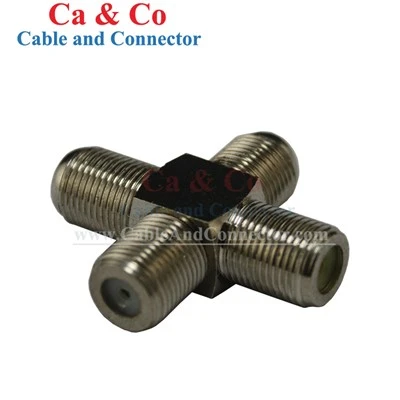
Wait, let’s clear up a common myth here: you can’t plug an F plug into another F plug, right? And you can’t plug an F jack into another F jack. That’s basic connector 101, but you’d be surprised how many new techs try that when they’re in a pinch. If you have two ends of coax cable and both are plugs, you need a coupler (or a barrel connector) that’s two jacks on each end to connect them. Same if you have a wall jack that needs to extend further—you get a female-to-female coupler. But here’s a pro tip from our team: don’t skimp on couplers. The cheap ones from the big box store can have plastic inner parts that crack, or loose threading, which causes signal loss. We supply heavy-duty metal couplers that are tested for 4K and even 8K signals, so you don’t get that pixelation or dropped channels.
Let’s talk about use cases because that’s where this stuff actually matters for your job or your home. If you’re a homeowner installing a new satellite dish, you’ll have two plugs: one on the dish cable and one on the cable that runs to your receiver. You twist those plugs onto the receiver’s jack—if the receiver has a screw-in jack, that’s a standard F jack. If you’re wiring a whole house for cable TV, you’ll mount jacks on every wall, then run plugs on the end of each room’s coax cable to plug into those wall jacks and into the back of your TV. For commercial installs, like office buildings, you’ll find jacks on distribution panels, and plugs on all the runs going to individual desks or conference rooms.
Now, why does mixing plug and jack up cause problems? Let’s say you grab the wrong end: you try to screw a wall jack onto your TV instead of the plug. That won’t thread at all, or if it does, the pin won’t line up right, so you get a fuzzy picture, or worse, no signal at all. We get calls every week from people who tried to install their own cable and messed up the plug on the coax, so they had to come replace it. Another big issue is weather resistance: if you’re using a plug outside (like on a satellite dish) and it’s not sealed right, rain can get in, cause corrosion, and kill the signal. That’s why we sell weather-sealed plugs for outdoor use—they have a rubber gasket on the barrel that compresses when you tighten it, keeping water out. Jacks for outdoor applications usually have a similar seal, so when you screw the plug on, the whole connection stays waterproof.
Wait, let’s get into some specs to make this real, no fancy terms. RG-6 is the most common coax now, right? It works for HDTV, satellite, and gigabit internet. For RG-6, standard F plugs have a 0.25-inch outer barrel, and the center pin is 0.032 inches thick. The jack is made to match exactly that, so when you twist them together, the threads catch perfectly. RG-59 is older, thinner coax, often used for old CCTV cameras. It has a smaller pin, so plugs and jacks for RG-59 are different—you can’t mix them with RG-6 parts. That’s another mistake we see: someone uses an RG-6 plug on an RG-59 jack, and it’s too big, so it doesn’t fit, or it damages the socket.
From a supplier’s perspective, one of the biggest things we hear from installers is that consistent parts save time. If a job uses all our F plugs and jacks, they don’t have to carry a bunch of adapters, and they know the signal will be strong. We test every single part we sell—we run signal loss tests, corrosion tests, and durability tests. We’ve had customers tell us they did a job with cheap plug parts, and a month later, half the connections were bad, so they had to come back and redo it. We supply F connectors that are built to last, so you don’t have to do that extra work.
Let’s also talk about how they look, because that’s the first thing people notice. A plug is longer, with that sticking pin—when you hold it next to a jack, the jack is shorter, with a little hole instead of a pin. The threads are on the outside of the plug’s barrel, and on the inside of the jack’s sleeve, which is why they twist together. It sounds simple, but it’s easy to mix up when you’re in a dark attic trying to connect a cable at 9 PM.
Another common question: is there a difference between “F plug” and “F male”? Honestly, for most people, they’re the same thing. Most F connectors are gendered that way, so the plug is male, jack is female. But sometimes, for panel-mount jacks, they call them female jacks, and that’s totally fine. The only time the term gets tricky is for some specialized F connectors, but for 99% of the stuff you’ll deal with at home or in most jobs, plug = male, jack = female, and they only fit each other.
Now, let’s get to the practical stuff: how to tell a plug vs a jack in a pinch. If it’s on the end of a loose coax cable, it’s a plug. If it’s screwed into something (a wall, a TV, a box), it’s a jack. That’s the easiest way to remember. No need to overthink it. If you’re trying to connect two cables, you need a coupler that’s two jacks, right? Because each cable has a plug, so you need something for each plug to screw into. If you’re extending a cable run, same thing: you take the plug on the end of your existing cable, screw it into one end of the coupler, then run a new cable with a plug on the other end of the coupler.
Let’s address some common mistakes we see: people forcing a plug into a jack too hard, which can bend the center pin, making the connection bad. Or using a screwdriver to twist the plug instead of a wrench, which can strip the threads. That’s why we always recommend using the right tools—for compression plugs, use a compression crimp tool, not a pair of pliers. For screw-on plugs, use a coax wrench to get a tight, even twist.
From a supplier standpoint, we’re here to help, not just sell parts. If you’re a DIYer trying to set up your home internet, or a big commercial installer working on a new office building, we can help you pick the right plugs and jacks for your application. Outdoor use? We’ve got weather-sealed ones. High-speed internet for gigabit plans? We sell F connectors that support up to 3 GHz, which is more than enough for today’s fastest services. Satellite or 4K TV? Our gold-plated jacks and plugs prevent corrosion and signal loss, so you get crystal-clear picture every time.
At the end of the day, the F connector plug vs jack difference is basic, but getting it right makes a huge difference in your setup. Mixing them up leads to bad signals, extra work, and frustrated customers (or frustrated you, if you’re doing it at home). We’ve been supplying these parts for years, and we’ve seen every mistake in the book—so trust me, the right plug for your cable end, the right jack for your wall or device, and using the right tools will save you so much time and hassle.
If you’re working on a project right now and need F connectors, whether it’s a small home job or a big commercial installation, don’t hesitate to reach out to us to talk through your needs. We can help you pick the right plugs, jacks, and couplers, answer any questions you have, and make sure your setup works perfectly. No part is too small, no project is too big—we’re here to help you get it done right the first time.
Scotchlok Connector References:
- The coax cable association handbook: F connector standards and applications, 2022 edition.
- National electrical code guidelines for low-voltage coaxial connections, 2023.
- RF signal loss testing protocols for F connectors, International Electrotechnical Commission, 2021.
- Residential broadband installation best practices, Satellite Industry Association, 2020.
Zhejiang Cable and Connector Optic Co., Ltd.
As one of the most professional f connector manufacturers and suppliers in China, we have world-leading production equipment and strong manufacturing capabilities. Please rest assured to wholesale custom made f connector at competitive price from our factory.
Address: 1517 East Communications Building, No.398, Wensan Road, Xihu District, Hangzhou City, Zhejiang Province, China.
E-mail: Sales@CableAndConnector.com
WebSite: https://www.zjcableandconnector.com/
